

BY DAVID LIU
ABSTRACT
The Biden-Harris Administration’s federal student loan debt relief plan aims to relieve student loan debt burdens from the United States. Their relief plan impacts the overarching national economy with multifaceted effects on the economy and attainment of vital life milestones. This paper explores the multifaceted effects and their impacts. It utilizes a Cost-Benefit Analysis to assess the potential limitations and transformative impact the plan could have on America’s socio-economic landscape. The contents of this paper highlight the complex interplay between the economy and societal well-being and the many factors that affect policymaking.
Introduction
It is important to outline the substantial student loan debt in the United States and address the challenges posed by it. Student loan debt in the United States adds up to about 1.76 trillion dollars with 1.65 (93%) trillion dollars being federal loans. Federal student loan debt is held by 43.6 million borrowers with an average debt balance of around 38 thousand dollars. At public four-year institutions, 55% of students have student loans. At private nonprofit four-year institutions, 57% of students have education debt (Hahn). Student loan debt in the United States has been increasing at a much faster rate than the number of federal student borrowers (Hanson). The Biden-Harris Administration introduced a long-term federal student loan debt relief plan in August of 2022 as an effort to fix “past administrative failures” (“Biden-Harris Administration to Provide”). Despite being overruled by the U.S. Supreme Court the following year, the Biden-Harris Administration has pursued alternatives such as the Saving on a Valuable Education (SA VE) Plan. The SA VE Plan is an income-driven repayment (IDR) plan that the Biden-Harris Administration estimates will benefit over 20 million borrowers with benefits that are essential to low and middle-income borrowers. It works to cut payments on undergraduate loans in half as payments will be reduced from 10% to 5% of borrowers’ discretionary income (“The Biden-Harris Administration Launches the SA VE Plan”). However, IDR plans such as the Save plan forgive student loan debt after a certain amount of payments or time. For example, the Biden-Harris Administration has canceled nearly 132 billion dollars of student debt for more than 3.6 million Americans (“Biden-Harris Administration Announces”). The administration plans to continue student debt relief by forgiving an additional 4.8 billion dollars for 80,300 borrowers (Nova). This approach articulates the administration’s commitment to addressing the challenges of student loan debt and promoting economic mobility for lower classes. Thus, the student loan relief plan poses an essential question, “Where is the money to fund all these expenses coming from?” The answer to that is the federal government. They have a choice to reduce spending or raise taxes. Either trade-off could be costly, cutting into vital social programs, or adversely impacting the general public – the taxpayers. The controversial aspect of the SA VE Plan and student loan debt forgiveness questions the costs and benefits of the Biden-Harris Administration’s new policy. The implementation of this plan will be important to the financial well-being of countless individuals and the stability of education. This contribution to the extensive policy discussions about student loan debt relief and the attainment of higher education provides a comprehensive insight for advocates and other stakeholders. This review paper assesses the effectiveness of the current student loan debt relief plan in addressing the needs of the overarching country through the use of the Cost-Benefit Analysis method. Additionally, it offers an analysis of the broader benefits of the plan on the economy and marginalized groups. Moreover, it delves into areas where the relief plan may be limited in effectively managing government spending. In this paper, the methodology for weighing costs and benefits is introduced. Next, two potential positive impacts of the student loan relief plan, small business growth and reducing the racial wealth gap, are highlighted and reviewed. Subsequent to that, unfairness and social programs are discussed in the negative impact section of this paper. Following the review of literature, a conclusion and limitations will be presented.
Methods
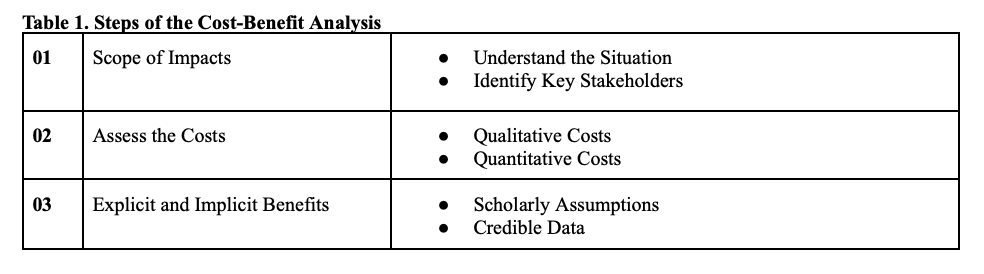
This paper keeps the criteria for inclusion of studies within a decade of the time of the writing, 2023 and 2024. Studies were selected by determining the information’s relevancy to the subtopics at hand. All studies selected are cited throughout this paper. This paper utilises a Cost-Benefit Analysis to assess the opportunity costs of potential benefits and determine potential risks and adverse impacts. Though there is not a single universally accepted method to perform a Cost-Benefit Analysis, this paper will follow a general rule of thumb. More specifically, the procedures of the Cost-Benefit Analysis are listed in Table 1. First, determine the scope of impacts by understanding the situation and identifying key stakeholders. Following this framework, assesses the costs, looking at both the qualitative and quantitative costs of the policy alluded to in this paper. Thirdly, tackle the challenge of examining both explicit and implicit benefits by making scholar-source-backed assumptions and reviewing data.
 Wanman
  Articles