

BY SEB G
The theory of evolution and all that associates with it is a widely successful and accepted explanation for why we are here today in the study of science and nature. It was theorised by Charles Darwin (1809–1882) following his observations, including those made during his time studying organisms from the Galápagos Islands, in response to the question: “how and why are we here?” Evolution is, in many ways, a long-term process in which heritable traits that confer a reproductive advantage become more common in a population over generations as organisms interact with their environment.
For example, Darwin’s finches (passeriformes, family Thraupidae) exhibit variation in beak size and shape. In certain environments, finches with smaller, more pointed beaks were better able to access food found in narrow gaps, meaning they were more likely to survive and reproduce. Finches with less suitable beak shapes were less likely to obtain enough food and therefore less likely to pass on their traits. Over many generations, this led to smaller, pointed beaks becoming more common within those populations. However, this does not mean that all other beak types died out, nor that evolution came to a standstill; evolutionary change continues as environments and selective pressures change. In other habitats, larger or rounder beaks may be more advantageous, demonstrating that natural selection operates differently depending on environmental conditions.
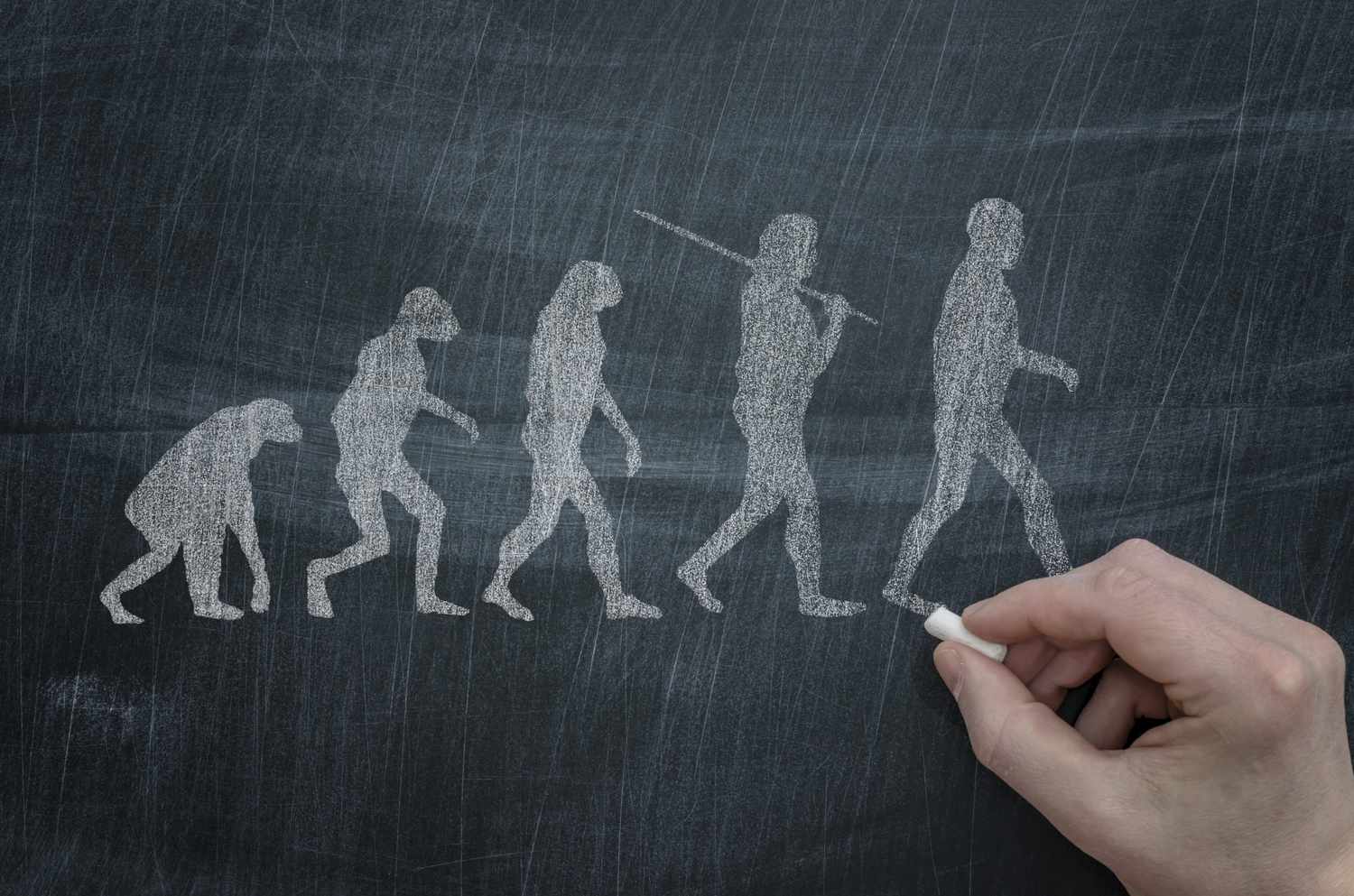
Scientists believe that humans evolved through similar processes of variation and natural selection, sharing common ancestry with other primates rather than appearing suddenly in their present form. With Darwin discovering and publishing this theory in On the Origin of Species, it challenged many philosophical arguments that sought to explain the existence and origin of humanity. In this essay I will argue how and why evolution challenges the design and religious arguments.
One theory that stands in opposition to evolution is the Design Argument, proposed by William Paley (1743–1805). Paley describes stumbling across a rock and questioning how it came to be there, concluding that it could plausibly have existed for an eternity. However, if one were to find a mechanical watch, it would be unreasonable to assume it had existed forever, as its intricate and ordered structure suggests it was designed for a purpose. Paley argues that, by analogy, complex natural objects must also have a designer. Humans, being far more complex than a watch, appear to support this conclusion.
However, the theory of evolution directly challenges this reasoning. Paley assumes that complexity requires intentional design, whereas Darwin’s theory explains how complexity can arise gradually through numerous small, successive modifications over vast periods of time. Darwin himself stated: “If it could be demonstrated that any complex organ existed, which could not have been formed by numerous, successive, slight modifications, my theory would absolutely break down. But I can find no such case.” Fossil evidence supports this gradual process, showing organisms that lived before humans, such as dinosaurs and early mammals. Following the extinction of non-avian dinosaurs, mammals diversified and occupied many ecological niches, alongside other surviving groups such as birds and reptiles. This evidence suggests continuity and gradual change rather than sudden creation.
If humans had appeared suddenly without evolutionary precursors, it would be difficult to explain how they could survive without inherited adaptations. Instead, humans are born without innate knowledge and must learn language, behaviour, and skills through socialisation. This supports the evolutionary view that humans, like other animals, are shaped by both biological inheritance and environmental influence. From an evolutionary perspective, humans share the same fundamental drives as other living organisms: survival and reproduction. As Darwin stated, “Man selects only for his own good; Nature only for that of the being which she tends.”
Religion is also challenged by the hypothesis of evolution. Many religious accounts, such as the creation narrative in Genesis, propose that humans were specially created to live and thrive. While this aligns loosely with the idea of reproduction and continuation of life, religious texts do not account for the extensive fossil record or the long history of life on Earth revealed by modern science. For example, dinosaurs and many extinct species are not mentioned in the Bible, reflecting the limited scientific knowledge available at the time these texts were written. Modern methods such as radiometric dating indicate that humans appeared long after many other organisms, including dinosaurs.
Evolution remains the most comprehensive scientific explanation for the diversity of life, supported by evidence from fossils, genetics, and observed biological change. While philosophy and religion attempt to answer questions of meaning and purpose, evolution provides a robust account of how life developed through natural processes. In conclusion, although philosophical and religious arguments offer perspectives on human existence, evolutionary theory is grounded in extensive empirical evidence and provides a stable framework for understanding the origins and development of life on Earth.