

BY CALEB YAP
- Introduction:
In the 19th and 20th centuries, polio left many people confined to “iron lungs” due to the paralysis caused by damage to the nervous system, making independent breathing impossible. The disease was widely feared, not only for its lifelong effects but also for its ability to cause rapid, devastating epidemics. So, how has treatment progressed so rapidly for this once-dreaded illness?
Polio is a virus that has existed since ancient times (even as far back as the Egyptian era). This is evident from ancient paintings that depict children with canes and withered limbs, symptoms consistent with polio (WHO). The virus is primarily transmitted through sewage-contaminated water, and more rarely through coughs and sneezes. Once ingested or inhaled, poliovirus infects the intestines and nervous system. Interestingly, about 75% of infected individuals remain asymptomatic, yet the virus can still have long-term effects. In some cases, symptoms appear decades later, even in those who were originally asymptomatic. This delayed condition, known as post-polio syndrome, causes progressive muscle weakness and disability (NYS, Polio).
The ability of polio to spread silently and undetected is one of the key reasons it was—and in some areas still is—so feared. In regions with low vaccination coverage, this silent transmission can lead to sudden and severe outbreaks.
2. Vaccines:
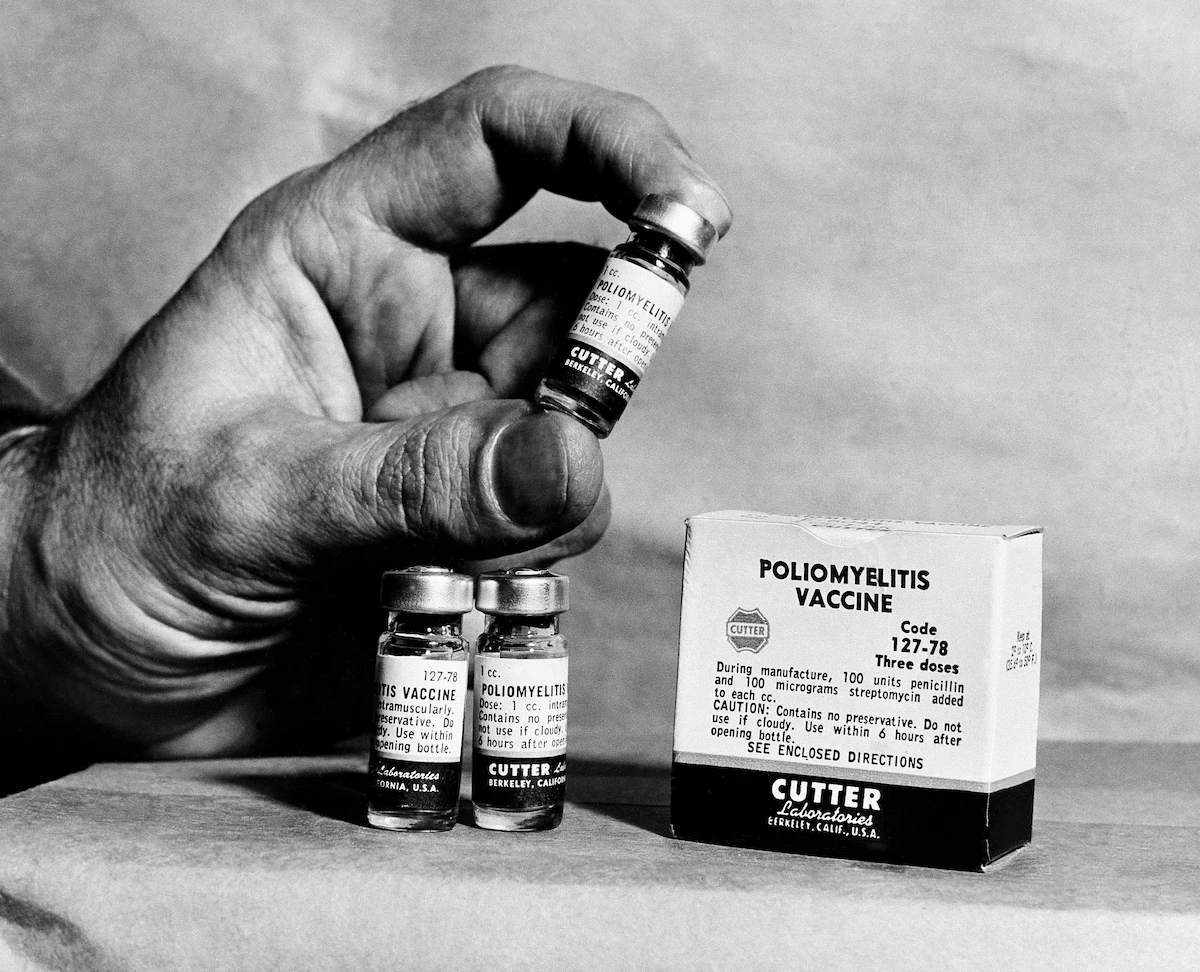
The injected polio vaccine, first developed in the U.S., was made using inactivated poliovirus (IPV) and proved highly effective. Just two doses offer around 90% protection against paralytic polio (where the virus causes partial or complete paralysis) and three doses increase protection to about 99% (CDC, 2019). In the UK, children receive three doses in infancy (at 8, 12, and 16 weeks), a pre-school booster (age 3), and a teenage booster (around 14 years). These are typically delivered as part of combination vaccines that also protect against other diseases.
IPV is effective against all three wild poliovirus serotypes, as well as vaccine-derived polioviruses (VDPVs). While IPV protects individuals from symptoms, it does not stop the virus from replicating in the gut, meaning vaccinated people can still carry and transmit polio. This makes widespread vaccination crucial, as unvaccinated people remain vulnerable, similar to how COVID-19 vaccines reduce disease severity but may not fully block transmission.
The second vaccine used is the oral polio vaccine (OPV), which contains a weakened (attenuated) but live form of the virus. Because it is taken orally, it was easier to administer, especially in mass campaigns, and played a key role in the global fight to eradicate polio. OPV also provides gut immunity, meaning vaccinated individuals typically stop shedding wild virus within a week, breaking the chain of transmission. Interestingly, the OPV was developed during the Cold War by a collaboration between an American physician and Russian virologists, lending credibility to its adoption by the WHO.
However, the use of OPV brought new risks. In areas with low vaccination coverage, the weakened virus can circulate for long periods, gradually mutating. These mutations can revert the virus to a dangerous form capable of causing paralysis—this is known as vaccine-derived poliovirus (VDPV) (CDC, 2022). The risk is particularly high in immunocompromised individuals, who may shed the virus for extended periods, increasing the chance of dangerous mutations.
This risk led countries like the UK and U.S. to phase out OPV from routine use, relying instead on IPV. Still, OPV is occasionally used in emergency settings, such as in conflict zones like Gaza, where stopping transmission rapidly is critical. A notable example of OPV’s risk was in 2022, when vaccine-derived poliovirus type 2 (VDPV2) was found in London sewage, triggering a booster campaign for children under 10.
In response to the VDPV problem, researchers developed a new, genetically engineered oral polio vaccine in 2021–2022 (BBC, 2023). These vaccines are designed to be over 50 times more genetically stable, keeping the weakened virus “locked” in a safe form. The updated vaccine protects against all three wild poliovirus types, and the type 2 version alone has been used over 650 million times worldwide, marking a major step toward global eradication.
3. Conclusion:
The polio vaccine is a vaccine which has helped the lives of billions of people and has changed polio from a feared disease to one where, ironically, the vaccine-derived viruses cause greater problems today than those “in the wild.” Even so, both the OPV and IPV have helped on the road to permanently eradicating polio and has made it so that polio is now endemic to only Pakistan and Afghanistan, compared to worldwide in 1988.
1-World Health Organization. History of Polio Vaccination [Internet]. World Health Organization. World Health Organization; 2025. Available from: https://www.who.int/news-room/spotlight/history-of-vaccination/history-of-polio-vaccination
2-New York State Department of Health. Polio (Poliomyelitis, Infantile Paralysis) [Internet]. www.health.ny.gov. 2022. Available from: https://www.health.ny.gov/diseases/communicable/polio/
3-CDC. Polio Vaccine Effectiveness and Duration of Protection [Internet]. Centres for disease control and prevention. 2019. Available from: https://www.cdc.gov/vaccines/vpd/polio/hcp/effectiveness-duration-protection.html
4-CDC. Polio Vaccine [Internet]. Centres for Disease Control and Prevention. 2022. Available from: https://www.cdc.gov/vaccines/vpd/polio/hcp/vaccine-derived-poliovirus-faq.html
5-Super-engineered vaccines created to help end polio. BBC News [Internet]. 2023 Jun 14; Available from: https://www.bbc.co.uk/news/health-65860202
 Articles